
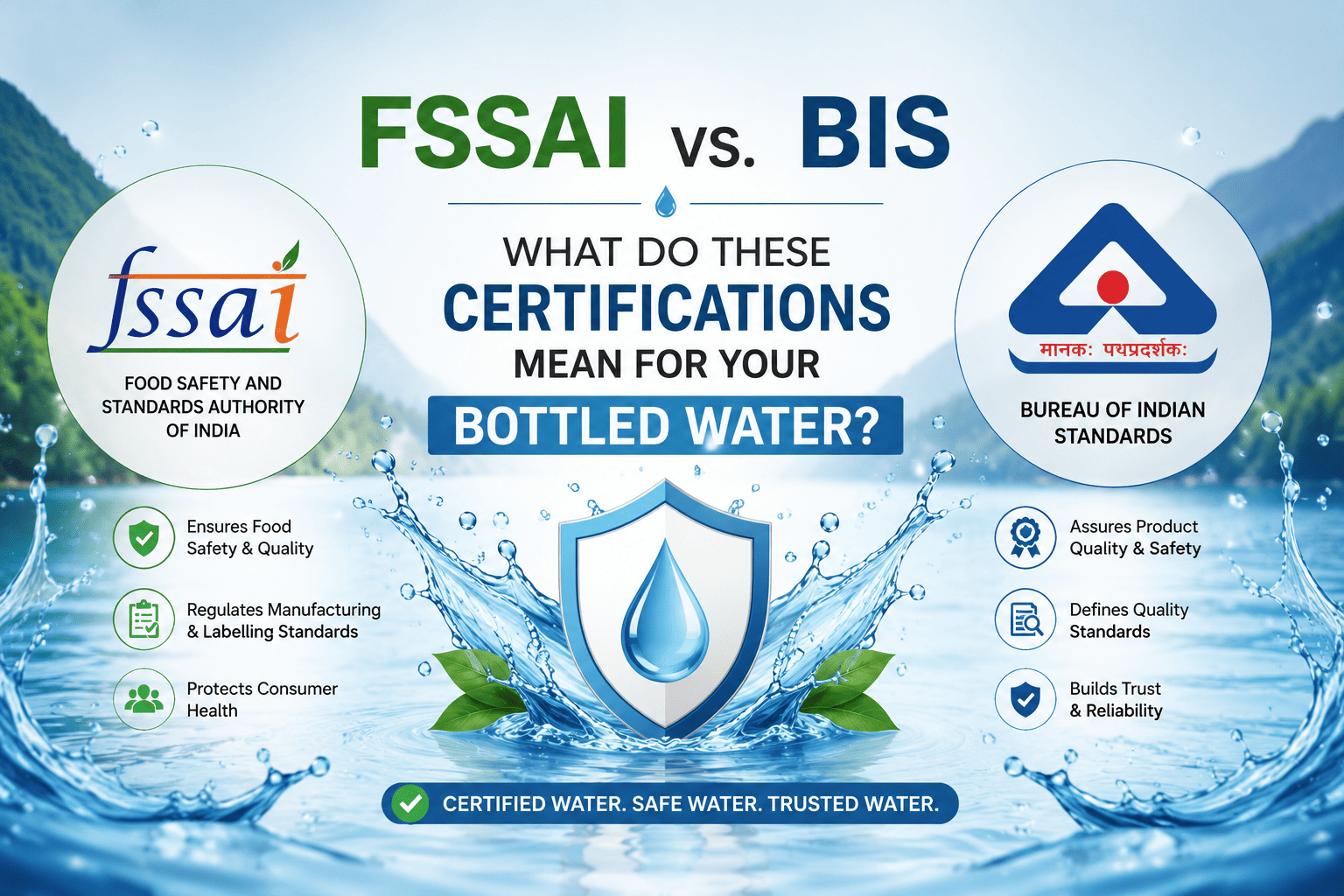
FSSAI and BIS: The Roles They Used to Play
Until recently, two regulators shared oversight of packaged drinking water in India.
FSSAI (Food Safety and Standards Authority of India) is the country's central food safety regulator. Because packaged water is legally classified as a food product, every bottling company — Bestone Water included — must hold a valid FSSAI license to manufacture and sell it. FSSAI's job has always been about the business as a whole: hygiene practices, facility standards, accurate labeling, and overall food safety compliance under the Food Safety and Standards Act, 2006.
BIS (Bureau of Indian Standards) historically played a narrower, more technical role. It certified the water itself against a specific quality standard — IS 14543 for packaged drinking water, and IS 13428 for packaged natural mineral water. Bottlers that cleared BIS's lab testing and plant inspection received a Certification Mark/License number and could display the familiar ISI mark. Until late 2025, this wasn't optional — the ISI mark was a legal requirement for selling packaged water commercially in India.
What's Changed: BIS Certification Is No Longer Mandatory
In an order dated December 17, 2025, FSSAI removed provisions that made BIS certification mandatory for packaged drinking water and mineral water, building on an earlier notification issued on October 17, 2024.
As a result, bottled water manufacturers are no longer legally required to carry the BIS ISI mark. However, this is not a relaxation of standards — it is a shift in how those standards are enforced.
What Replaced It: A Continuous Testing Regime
FSSAI introduced a new Scheme of Testing for Packaged Drinking Water and Mineral Water, making ongoing testing mandatory from January 1, 2026.
- Regular testing through NABL-accredited labs
- Monthly microbiological testing (coliform, Salmonella, etc.)
- Maintain 5 years of compliance records
- Immediate action on failed batches
- Packaging material testing for safety
- Strict reuse rules for large containers
Why This Matters — and Why It's a Good Thing
This shift moves from a one-time certification model to continuous accountability. Reports of contamination in various regions highlighted the need for stricter monitoring.
With India's packaged water market growing rapidly, regulators have focused on ensuring real-time quality rather than relying on periodic approvals.
What You Should Check on a Bottle Now
- FSSAI license number (most important)
- Proper sealing and packaging
- Batch number and expiry date
- Clear labeling (packaged water vs mineral water)
No ISI mark does not mean the product is unsafe — compliance now depends on ongoing testing rather than just certification.
Our Commitment at Bestone Water
At Bestone Water, we follow multi-step purification, strict quality checks, and continuous monitoring systems across all our plants.
Our focus has always been on delivering safe, reliable drinking water through advanced filtration, automated sanitation, and consistent testing — not just certifications.
Regulations may evolve, but our commitment to quality remains constant.