
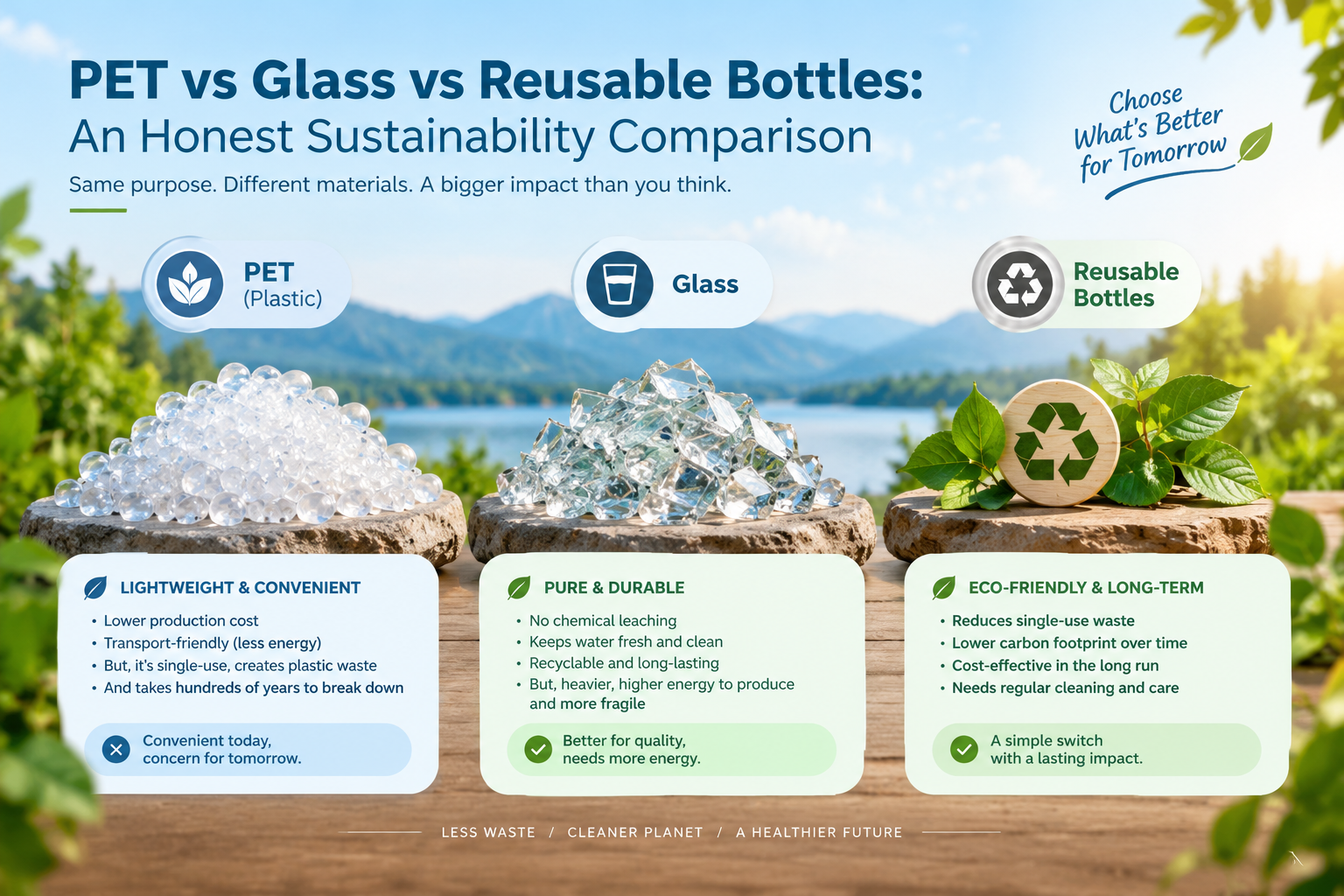
When you buy a bottle of water, the water itself is only one part of the environmental story. The bottle surrounding it also has an impact—from the raw materials and manufacturing process to transportation, use, recycling, and final disposal.
PET plastic, glass, and reusable bottles are often presented as simple choices: plastic is bad, glass is better, and reusable bottles are best. But sustainability is more complicated than that.
The environmental impact of a bottle depends on several factors, including how much material is used, how far the bottle travels, whether it is reused, how it is cleaned, and whether it is actually recycled at the end of its life.
So, which bottle is the most sustainable?
The honest answer is: it depends on how the bottle is produced, used, transported, and disposed of.
Let’s compare PET, glass, and reusable bottles across their complete life cycles.
PET Bottles: Lightweight and Efficient, but Designed for Single Use
PET, or polyethylene terephthalate, is one of the most widely used materials for packaged drinking water and other beverages.
One of PET’s biggest environmental advantages is its low weight. A lightweight PET bottle requires relatively little material and is much easier to transport than heavier packaging such as glass.
Less weight can mean:
- Lower transportation requirements
- More bottles transported per vehicle
- Lower fuel consumption per bottle
- Lower transportation-related emissions
- Efficient use of packaging material
This is particularly important for packaged drinking water because water itself is heavy. Adding a heavy container can significantly increase the amount of energy required to move the product from the manufacturing facility to the customer.
The problem with single-use PET
The biggest environmental challenge with PET isn’t simply the material. It is the single-use consumption model.
Consider someone who consumes approximately one litre of packaged water every day. If every litre is purchased in two 500 ml bottles, that can mean hundreds of bottles over the course of a year.
Even if each individual bottle has a relatively small environmental footprint, repeated consumption creates a much larger cumulative impact.
That makes collection and recycling extremely important.
PET is recyclable and can be converted into new packaging, polyester fibres, and other products. However, a bottle can only be recycled if it is properly collected, sorted, processed, and sent into an appropriate recycling stream.
PET recycling: collection is not the same as recycling
One important distinction is often overlooked in sustainability discussions:
A bottle being collected does not necessarily mean it is successfully recycled.
Collection systems can experience losses during sorting, contamination, transportation, and processing. Recycling infrastructure also differs significantly between countries and regions.
This means improving PET sustainability requires more than simply producing recyclable bottles. It requires an effective collection, segregation, recycling, and recovery system.
For consumers, one of the simplest actions is to avoid littering and place used PET bottles into the appropriate recycling or waste-collection system.
Glass Bottles: Recyclable, Durable, but Heavy
Glass has a strong reputation for sustainability.
It is durable, chemically stable, and can be recycled repeatedly without fundamentally changing the material. Unlike some other packaging materials, glass can be remelted and used to manufacture new glass products.
But there is another side to the story.
Manufacturing glass requires significant energy
Glass is manufactured by melting raw materials at very high temperatures. Maintaining these temperatures requires substantial energy.
The environmental impact therefore depends heavily on:
- The energy source used during manufacturing
- The amount of glass used
- The percentage of recycled glass in production
- The efficiency of the manufacturing facility
- Transportation distance
The biggest disadvantage of glass for packaged water is often its weight.
A glass bottle can weigh considerably more than an equivalent PET bottle. When thousands of bottles are transported over long distances, that additional weight can increase fuel consumption and transportation emissions.
This is why comparing materials only on the basis of whether they are recyclable can be misleading.
Recyclable doesn’t automatically mean sustainable
Glass can be recycled, but recycling still requires collection, transportation, processing, and energy.
A disposable glass bottle that is manufactured in one location, transported a long distance, used once, and then discarded has a very different environmental profile from a glass bottle that is collected locally, washed, refilled, and reused many times.
And that brings us to one of the most important distinctions in this comparison.
Returnable Glass vs Disposable Glass
Not all glass bottles should be considered environmentally equivalent.
A single-use glass bottle and a returnable glass bottle operate under very different systems.
In a returnable system, the bottle is:
- Delivered to the customer
- Collected after use
- Transported back
- Cleaned and inspected
- Refilled
- Delivered again
The manufacturing impact of the original bottle is therefore distributed across multiple uses.
If the same bottle is successfully reused many times, its environmental impact per use can decrease significantly.
However, returnable systems work best when the entire logistics network is efficient.
High return rates, short transportation distances, efficient washing, and a well-organized distribution system can all improve the environmental performance of reusable glass packaging.
Reusable Bottles: The Advantage Comes From Reuse
Reusable bottles made from stainless steel, glass, or durable plastic have one major advantage:
They are designed to be used repeatedly.
Instead of manufacturing and disposing of a new bottle every time you drink water, one reusable bottle can serve you for months or years.
However, reusable doesn’t automatically mean environmentally superior from the first use.
Manufacturing a durable bottle requires more material than manufacturing a lightweight single-use bottle.
The environmental benefit appears when that initial manufacturing impact is spread across many uses.
The more you reuse, the better the economics of the footprint
Imagine a stainless steel bottle that requires significantly more resources to manufacture than a lightweight PET bottle.
If you purchase it and stop using it after a few weeks, its environmental advantage may be limited.
But if you use the same bottle every day for several years, the manufacturing impact is distributed across hundreds or thousands of uses.
This is the central principle behind reusable packaging:
Durability only creates an environmental advantage when the product is actually reused for a long enough period.
The Hidden Factor: Washing Your Reusable Bottle
There is another part of reusable bottles that is frequently ignored: cleaning.
A reusable bottle needs to be washed regularly. That means using water, cleaning products, and potentially energy.
The environmental impact of cleaning depends on factors such as:
- How frequently the bottle is washed
- Water temperature
- Amount of water used
- Cleaning method
- Energy source
- Dishwasher efficiency
For this reason, sustainability isn’t simply about buying a stainless steel or glass bottle.
It is also about using it efficiently and keeping it for a long time.
A reusable bottle that is used hundreds of times and cleaned efficiently can have a much lower impact per use than repeatedly purchasing single-use bottles.
PET vs Glass vs Reusable Bottles
Compare the environmental impact of different bottle types and understand which option works best in different scenarios.
| Factor | ♻ PET Bottle | ◇ Glass Bottle | ↻ Reusable Bottle |
|---|---|---|---|
| Weight | Very lightweight | Heavy | Depends on material |
| Manufacturing | Relatively material-efficient | Energy-intensive | Higher initial material use |
| Transportation | Generally efficient | Higher weight increases transport impact | Depends on material |
| Reuse | Usually designed for single use | Possible in returnable systems | Main purpose |
| Recycling | Widely recyclable | Highly recyclable | Depends on material |
| Waste Risk | High if improperly discarded | Lower litter persistence, but still waste | Very low when used long-term |
| Best Environmental Scenario | Efficient collection and recycling | High-return local refill system | Long-term repeated use |
| Biggest Challenge | Single-use consumption and waste | Weight and manufacturing energy | Production impact and washing |
The table highlights an important point: there is no single material that wins every category.
So, Which Bottle Is the Most Sustainable?
The answer depends on how you use it.
For everyday personal hydration
A durable reusable bottle can be an excellent choice if you use it regularly for a long period.
The key isn’t simply buying a reusable bottle. The key is using the same bottle again and again.
For packaged water on the go
PET can offer important practical advantages because it is lightweight, durable, and efficient to transport.
The environmental priority then becomes proper collection and recycling.
For local return-and-refill systems
Returnable glass can be an attractive option when bottles are collected efficiently, washed, refilled, and reused many times within a relatively local distribution network.
For events and large gatherings
The situation can be more complicated.
Weddings, religious gatherings, conferences, hotels, restaurants, schools, offices, and other large events may require hundreds or thousands of servings of drinking water.
In these situations, the environmental impact depends on the packaging format, transportation distance, consumption volume, collection system, and what happens to the bottles afterward.
The goal should not simply be to select a material because it sounds environmentally friendly. Instead, organizers should consider the entire supply and recovery system.
5 Practical Ways to Make Bottled Water More Sustainable
You don’t need to completely eliminate packaged water to make better environmental choices.
Here are five practical steps.
1. Use Reusable Bottles When Practical
If you’re at home, in the office, or travelling somewhere with safe drinking-water access, carrying a reusable bottle can reduce your dependence on single-use packaging.
The longer you use it, the more beneficial that initial manufacturing impact becomes.
2. Choose the Right Bottle Size
Packaging efficiency matters.
For situations where packaged water is necessary, selecting an appropriate bottle size can help avoid unnecessary packaging and product waste.
For large events, organizers can also plan quantities carefully to reduce unopened or unused bottles.
3. Never Litter PET Bottles
A recyclable bottle only has recycling value when it enters the recovery system.
Always dispose of used PET bottles through the appropriate waste or recycling channel.
Where possible, keep recyclable packaging separate from general waste.
4. Look for Recycled Content
Using recycled PET can reduce the demand for virgin plastic compared with producing bottles entirely from new raw materials.
As recycling systems improve, increasing recycled content can become an important part of creating a more circular packaging economy.
5. Think Beyond the Bottle
Sustainability isn’t just about choosing PET, glass, or stainless steel.
Consider the complete system:
Raw materials → Manufacturing → Transportation → Use → Collection → Recycling/Reuse
A packaging system that performs well across all six stages can be more sustainable than one that looks environmentally friendly at only one stage.
What About Microplastics?
Plastic pollution and microplastics are important environmental concerns, but the conversation should be based on evidence rather than fear.
Plastic packaging can contribute to environmental plastic pollution when waste is poorly managed.
However, the presence of a plastic bottle does not automatically mean that every use creates the same environmental impact.
Good waste management, high collection rates, recycling, responsible manufacturing, and reduced unnecessary consumption are all important parts of addressing the problem.
Consumers should therefore focus not only on what a bottle is made from, but also on what happens to it after use.
The Real Sustainability Question: Material or System?
This may be the most important lesson from comparing PET, glass, and reusable bottles.
Sustainability is not simply:
Plastic = bad
Glass = good
Reusable = best
The real equation is more complicated.
A lightweight PET bottle that is properly collected and recycled can have a different environmental profile from a glass bottle transported hundreds of kilometres.
A returnable glass bottle used dozens of times can perform very differently from a single-use glass bottle.
And a stainless steel bottle used every day for five years can have a very different footprint from one that sits unused in a cupboard.
The system matters.
Bestone Water’s Approach to Responsible Packaging
At Bestone Water, we understand that packaged drinking water serves an important role in many situations—from events and gatherings to hotels, restaurants, offices, institutions, and other commercial requirements.
We also recognize that packaging creates an environmental responsibility.
That responsibility includes using packaging efficiently, supporting responsible waste management, encouraging proper disposal and recycling, and continuing to look for ways to improve the environmental performance of our operations.
For businesses and event organizers, sustainability can also begin with better planning:
- Order quantities based on realistic consumption
- Avoid unnecessary packaging
- Ensure bottles are collected after events
- Keep recyclable waste separate
- Work with responsible waste-collection systems
- Consider reusable solutions where practical
- Choose suppliers that take packaging and responsible production seriously
There is no perfect packaging solution for every situation.
The better goal is to reduce unnecessary consumption, maximize reuse where practical, improve recycling, and make decisions based on the entire life cycle of the product.
Final Verdict: PET vs Glass vs Reusable Bottles
So, which is better—PET, glass, or reusable bottles?
For repeated personal use: a durable reusable bottle is often the most practical sustainable choice when it is used for a long time.
For single-use packaged water: lightweight PET can have advantages because of its low weight and transportation efficiency, particularly when effective collection and recycling systems are available.
For closed-loop local systems: returnable glass can perform well when bottles are reused many times with efficient collection, washing, and distribution.
The most sustainable choice isn’t determined by the word “plastic,” “glass,” or “reusable” printed on the packaging.
It is determined by what happens before, during, and after you use the bottle.
So the next time you pick up a bottle of water, don’t ask only:
“What is this bottle made from?”
Also ask:
“How many times will it be used, how far did it travel, and what will happen to it after I’m finished?”
That is where the real sustainability conversation begins.