
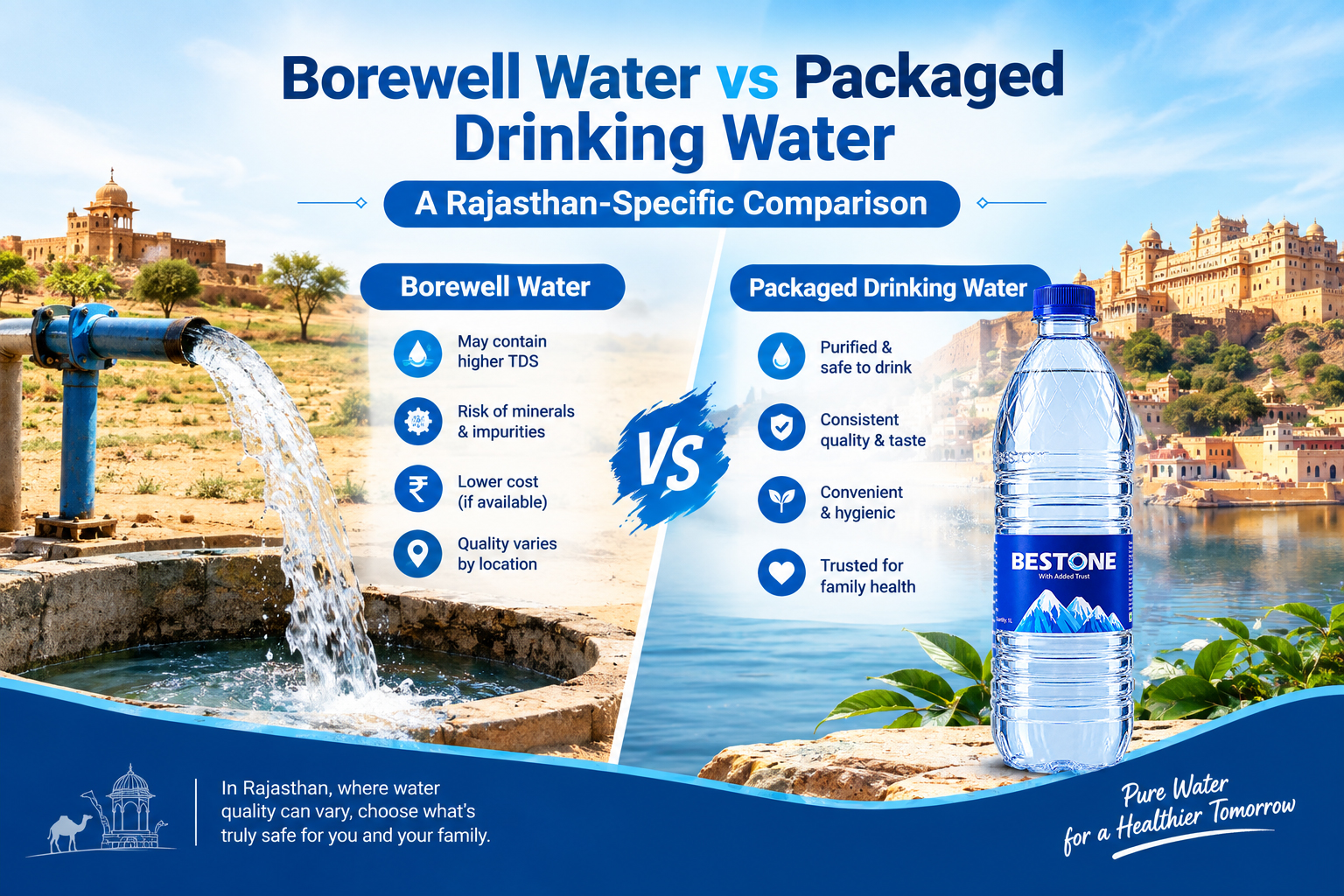
Water is one of the most essential requirements for daily life. However, the quality of drinking water can vary significantly depending on its source. In Rajasthan, where the climate is largely dry and groundwater is an important source of water, many homes, businesses, schools, hotels, and industries depend on borewell water.
At the same time, concerns about groundwater quality have increased the demand for packaged drinking water. But which option is better—borewell water or packaged drinking water?
The answer depends on several factors, including water quality, treatment, location, convenience, cost, and regular testing.
In this article, we compare borewell water and packaged drinking water from a Rajasthan-specific perspective and explain why the source and treatment of drinking water matter.
Understanding Rajasthan’s Water Situation
Rajasthan has unique water challenges because of its arid and semi-arid climate. Rainfall is limited and unevenly distributed across the state, which means groundwater plays an important role in meeting daily water requirements.
However, groundwater quality is not the same throughout Rajasthan. The quality can vary significantly from one district, city, village, or even locality to another.
Government groundwater assessments have identified issues such as:
- High salinity and dissolved solids
- Excess fluoride
- High nitrate levels
- Hard water
- Other naturally occurring or location-specific contaminants
The Central Ground Water Board has reported groundwater quality concerns in Rajasthan related to parameters such as TDS, fluoride, nitrate, iron, arsenic, and uranium.
This makes it important not to assume that all borewell water is automatically suitable for direct drinking.
What Is Borewell Water?
Borewell water is groundwater extracted from underground aquifers using a borewell or tube well.
The water passes through layers of soil, rocks, minerals, and underground formations before reaching the aquifer. As a result, its quality depends heavily on the local geology and surrounding environmental conditions.
In Rajasthan, borewell water is widely used for:
- Drinking
- Cooking
- Bathing
- Washing
- Agriculture
- Commercial establishments
- Industrial purposes
However, the fact that water comes from underground does not automatically mean that it is safe to drink.
The quality must be tested.
What Is Packaged Drinking Water?
Packaged drinking water is water that is processed and filled into sealed bottles, jars, or other containers for human consumption.
The source water itself may come from different sources, including groundwater, municipal water, surface water, or other approved sources. The water then undergoes specified treatment processes before packaging.
Treatment may involve processes such as:
- Filtration
- Reverse osmosis
- Demineralization
- Disinfection
- Other necessary treatment processes
India’s packaged drinking water specification is covered under IS 14543:2024, which applies to packaged drinking water other than packaged natural mineral water.
The manufacturing and quality-control process is therefore very different from simply extracting water from a borewell and consuming it directly.
Borewell Water vs Packaged Drinking Water: Quick Comparison
Factor | Borewell Water | Packaged Drinking Water |
Source | Underground aquifers | Treated water from an approved source |
Quality consistency | Can vary significantly by location | Intended to follow specified quality requirements |
Treatment | May require additional treatment | Treated before packaging |
Fluoride risk | Can be high in some Rajasthan areas | Controlled through processing and quality requirements |
TDS | Can vary from low to very high | Controlled according to applicable standards |
Hardness | Often high in some locations | Usually treated for drinking suitability |
Nitrate risk | Can be a concern in some groundwater areas | Quality controlled during production |
Convenience | Available through an existing borewell | Ready to drink after opening |
Testing requirement | Regular local testing recommended | Manufacturer quality-control requirements apply |
Cost | Low extraction cost but treatment may be needed | Ongoing purchase cost |
Portability | Not portable | Easy to transport |
1. Water Quality: The Biggest Difference
The most important difference between borewell water and packaged drinking water is quality consistency.
Borewell water quality can change depending on:
- Geographic location
- Depth of the borewell
- Geological conditions
- Seasonal changes
- Agricultural activity
- Nearby industrial activity
- Sewage contamination
- Groundwater recharge conditions
For example, groundwater studies in Rajasthan have reported concerns related to fluoride, nitrate, salinity, and other quality parameters.
A groundwater assessment for Jaipur district reported that groundwater quality can be affected by fluoride, uranium, inland salinity, nitrate, and other pollutants.
This does not mean that all borewell water in Rajasthan is unsafe. Instead, it means that water quality must be checked based on the specific location.
One borewell may provide relatively good-quality water, while another borewell only a few kilometres away may require significant treatment.
2. TDS and Salinity in Rajasthan
TDS stands for Total Dissolved Solids. It represents dissolved minerals and salts present in water.
High TDS levels can affect:
- Taste
- Water hardness
- Scaling in appliances
- Overall drinking experience
Rajasthan’s arid and semi-arid conditions contribute to groundwater salinity issues in several areas. The Central Ground Water Board identifies inland salinity as a significant groundwater concern in arid and semi-arid regions, including Rajasthan.
Some groundwater may therefore taste:
- Salty
- Bitter
- Metallic
- Unpleasant
In such cases, direct consumption without proper treatment may not be suitable.
Packaged drinking water, on the other hand, goes through controlled treatment and quality processes designed to make it suitable for consumption according to applicable specifications.
3. Fluoride: A Major Rajasthan-Specific Concern
Fluoride is naturally present in groundwater because of geological formations and minerals.
In small amounts, fluoride is a naturally occurring component of water. However, excessive fluoride in drinking water can become a serious concern.
The Rajasthan Ground Water Year Book reported fluoride concentrations above the permissible limit in parts of the state and noted that groundwater quality with respect to fluoride varies significantly across regions.
This is particularly important for households that rely directly on borewell water.
You cannot determine fluoride levels by looking at the water.
Clear-looking water can still contain excessive fluoride or other dissolved contaminants.
Therefore, if your household depends on borewell water in Rajasthan, laboratory testing is highly recommended before deciding that the water is safe for drinking.
4. Nitrate Contamination
Nitrate is another parameter that may affect groundwater quality.
Groundwater nitrate levels can be influenced by factors such as:
- Agricultural activities
- Fertilizer use
- Waste disposal
- Sewage leakage
- Local environmental conditions
The Central Ground Water Board’s Rajasthan assessments have identified nitrate as one of the important groundwater quality parameters requiring monitoring.
Again, the important point is that groundwater quality is location-specific.
A borewell that was tested several years ago should not automatically be assumed to have the same water quality today.
5. Hardness and Household Problems
Many households in Rajasthan are familiar with hard water problems.
Hard water can lead to:
- Scaling on taps
- Reduced appliance efficiency
- Deposits inside geysers
- Scaling in pipes
- Soap not lathering easily
- White marks on utensils and bathroom fittings
High hardness does not automatically determine whether water is microbiologically safe or unsafe, but it is an important indicator of water quality and treatment requirements.
Some borewell water sources may require treatment systems specifically designed to reduce hardness and other dissolved minerals.
Packaged drinking water is generally treated for direct consumption, making it more convenient for drinking and cooking purposes.
6. Is Borewell Water Always Unsafe?
No.
It would be incorrect to say that all borewell water in Rajasthan is unsafe.
Some borewell sources may provide good-quality water, while others may have quality problems.
The correct approach is:
Test first, then decide.
A proper water test can help identify important parameters such as:
- pH
- TDS
- Hardness
- Fluoride
- Nitrate
- Chloride
- Sulphate
- Iron
- Heavy metals where relevant
- Microbiological contamination
Once the results are available, the appropriate treatment solution can be selected.
For example:
- High TDS may require RO or another suitable treatment approach.
- Microbial contamination may require disinfection.
- Specific dissolved contaminants may require specialized treatment.
Using a treatment system without first understanding the water quality may not always provide the best solution.
7. Convenience: Where Packaged Drinking Water Has an Advantage
Packaged drinking water offers significant convenience.
It is particularly useful for:
- Offices
- Hotels
- Restaurants
- Events
- Travel
- Schools
- Hospitals
- Construction sites
- Guest areas
- Homes without a reliable drinking-water treatment system
The biggest advantage is that the water is supplied in a sealed package and is ready for consumption.
For businesses, packaged drinking water can also simplify drinking-water management because there is no need to operate and maintain a large in-house treatment system for every consumption point.
8. Cost Comparison
At first glance, borewell water may appear to be cheaper.
However, the actual cost depends on the quality of the groundwater.
Borewell Water Costs May Include:
- Borewell installation
- Pump operation
- Electricity
- Storage tanks
- Water testing
- Filtration systems
- RO systems
- UV or other disinfection
- Maintenance
- Filter replacement
- Membrane replacement
If the groundwater has high TDS, fluoride, hardness, or other quality concerns, the treatment and maintenance costs can increase.
Packaged Drinking Water Costs Include:
- Purchase price
- Delivery charges where applicable
- Regular replacement of bottles or jars
For small drinking requirements, packaged water may be convenient.
For large and continuous consumption, a properly tested and professionally treated borewell-water system may be more economical in some situations.
Therefore, the best option depends on daily consumption volume and local water quality.
9. Environmental Considerations
Both options have environmental considerations.
Borewell Water
Excessive groundwater extraction can contribute to groundwater stress. In water-scarce regions, responsible extraction and conservation are important.
Packaged Drinking Water
Packaged water involves:
- Packaging materials
- Transportation
- Energy use
- Waste management
Reusable large water jars can reduce the amount of single-use packaging compared with individually purchased small bottles.
For Rajasthan, a sustainable long-term approach may involve:
- Responsible groundwater use.
- Rainwater harvesting where feasible.
- Regular water-quality testing.
- Proper treatment based on actual contamination.
- Responsible packaging and waste management.
10. Which Is Better for Rajasthan Homes?
There is no single answer for every household.
Borewell Water May Be Suitable When:
- The water is regularly tested.
- Test results show acceptable quality.
- Appropriate treatment is installed where required.
- The system is properly maintained.
Packaged Drinking Water May Be a Better Choice When:
- Borewell quality is uncertain.
- The water contains excessive dissolved contaminants.
- A household requires a convenient drinking-water solution.
- The treatment system is unavailable or unreliable.
- Water is needed temporarily for guests, events, or travel.
A Practical Approach: Use Borewell Water and Packaged Water Differently
For many households and businesses, the most practical solution may not be choosing only one source for every purpose.
For example:
Borewell Water Can Be Used For:
- Cleaning
- Washing
- Gardening
- Other non-drinking purposes
After appropriate treatment, it may also be suitable for other household uses depending on water-test results.
Packaged Drinking Water Can Be Used For:
- Drinking
- Serving guests
- Offices
- Events
- Restaurants
- Travel
This approach can help ensure that higher-quality drinking water is prioritized for human consumption.
How to Check Borewell Water Quality in Rajasthan
If you use borewell water for drinking, follow these basic steps to understand its quality and choose the right treatment.
Collect a Proper Water Sample
Use a clean container and follow the testing laboratory's instructions when collecting your borewell water sample.
Get the Water Tested
Check important physical, chemical, and microbiological parameters to understand the overall quality of your water.
Understand the Results
Do not focus only on TDS. A low or acceptable TDS reading does not automatically mean that water is safe from all contaminants.
Select the Right Treatment
Choose a suitable water-treatment system based on the actual water-quality test results.
Test Again Periodically
Water quality can change over time, so periodic testing helps you keep track of changes in your borewell water.
Why Brand and Quality Matter When Buying Packaged Drinking Water
Not all packaged products should be selected based only on price.
Consumers should check:
- Whether the package is properly sealed
- Manufacturing details
- Storage conditions
- Packaging condition
- Applicable quality and regulatory markings
- Whether the product has been handled and stored properly
Damaged or poorly stored bottles should be avoided.
Packaged drinking water is produced under specified standards and control requirements, including requirements related to source-water monitoring and microbiological quality control.
Borewell Water vs Packaged Drinking Water: Final Verdict
For Rajasthan residents, the comparison is not simply about which water is “better.”
The real question is:
Has the borewell water been properly tested, and is it being treated according to its actual quality?
Rajasthan’s groundwater conditions can vary significantly from one location to another. Issues such as fluoride, nitrate, salinity, TDS, and hardness make water testing especially important in many areas.
Untested borewell water should not automatically be considered safe for drinking.
On the other hand, properly tested and appropriately treated borewell water can be a useful source of water for households and businesses.
Packaged drinking water provides convenience and controlled processing for direct consumption, particularly when local groundwater quality is uncertain or when a reliable treatment system is not available.
The best decision depends on your location, water-test results, daily water requirements, and treatment infrastructure.
Frequently Asked Questions
It depends on the specific borewell and location. Borewell water should ideally be tested for relevant chemical and microbiological parameters before being used for drinking.
High levels of dissolved salts and minerals can affect groundwater taste. Salinity and high TDS are known groundwater concerns in parts of Rajasthan.
Boiling can help address certain microbiological concerns, but it does not remove dissolved salts, fluoride, nitrate, or many other chemical contaminants. The right treatment depends on the laboratory test results.
When borewell water quality is unknown or does not meet drinking-water requirements, properly processed packaged drinking water is generally the more convenient option for direct consumption.
The appropriate frequency depends on the source and local conditions. Periodic testing is advisable, especially if there are changes in taste, smell, appearance, nearby land use, flooding, or other environmental conditions.
Conclusion
Borewell water and packaged drinking water both have a role in Rajasthan. However, the key difference is that borewell water quality is highly dependent on local groundwater conditions, while packaged drinking water undergoes specified treatment and quality-control processes before being supplied in sealed containers.
For households and businesses in Rajasthan, the safest approach is simple:
Test your borewell water, understand the results, use the correct treatment, and choose reliable packaged drinking water whenever a convenient and controlled drinking-water option is needed.
For a state with diverse groundwater conditions like Rajasthan, water testing and informed treatment are more important than assumptions based on how clear or fresh the water looks.