
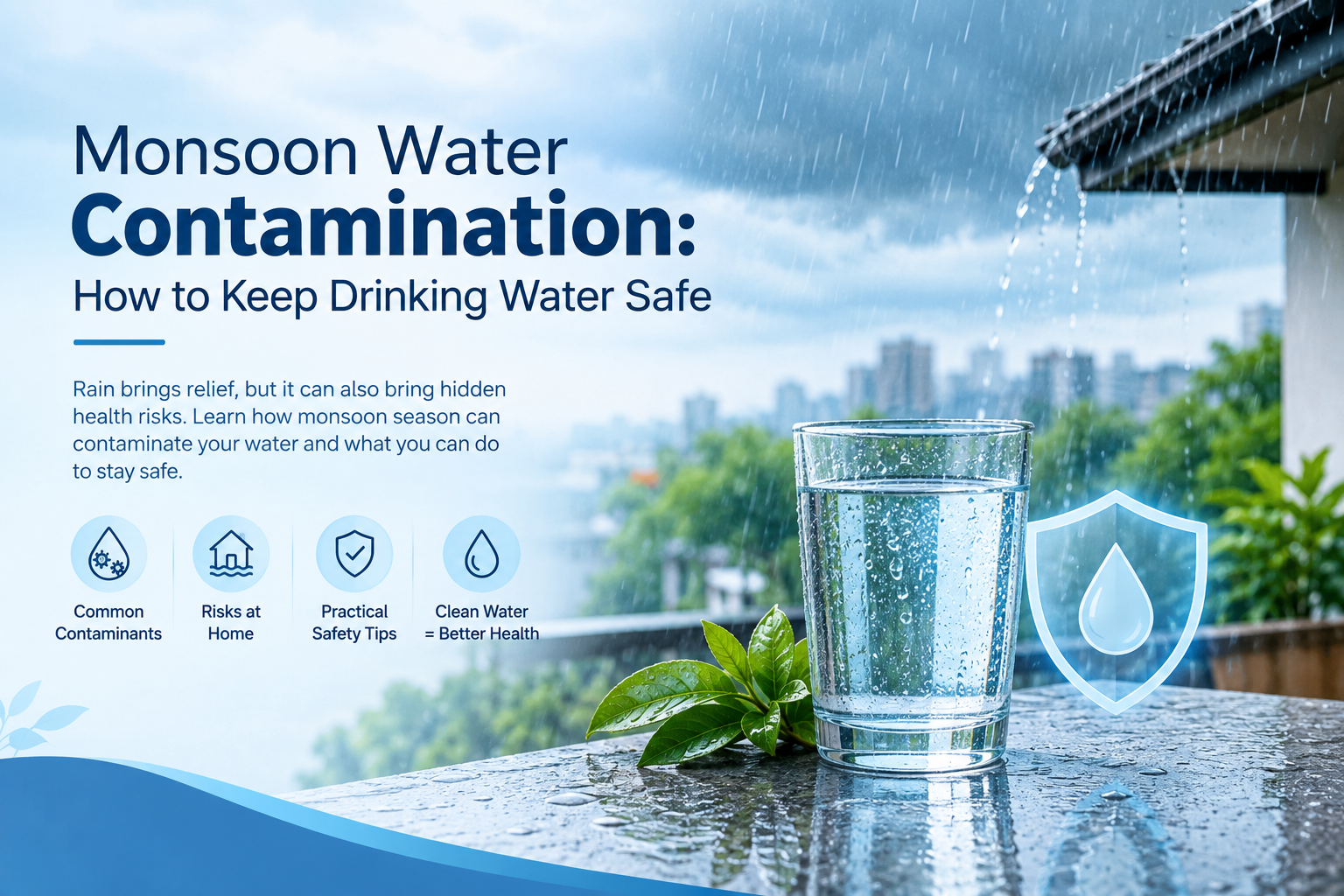
Why Does Water Contamination Increase During the Monsoon?
1. Rainwater Carries Surface Contaminants
Rainwater comes into contact with roads, soil, drains, agricultural areas, waste, and other surfaces before entering rivers, ponds, lakes, and groundwater recharge areas.
During heavy rainfall, this runoff can carry mud, organic waste, pesticides, fertilisers, and other pollutants into nearby water sources.
As a result, untreated or poorly protected water sources may become more vulnerable to contamination.
2. Sewage Overflow Can Affect Water Quality
Heavy rainfall can put pressure on drainage and sewage systems. In areas where drainage capacity is limited, sewage may overflow into streets, open areas, and low-lying locations.
Damaged or poorly maintained water pipelines can also become vulnerable to contamination when surrounding soil becomes waterlogged.
This is one reason why extra attention should be given to drinking water after periods of heavy rain.
3. Groundwater Can Also Be Affected
Borewell and groundwater are not automatically free from contamination.
During the monsoon, water can move through soil and carry contaminants toward shallow groundwater sources. Open wells, poorly sealed borewells, and water sources located close to septic tanks or drainage areas may be particularly vulnerable.
For this reason, groundwater quality should be tested periodically rather than judged only by its appearance.
4. Turbidity Can Increase
Heavy rainfall can disturb soil, silt, clay, and organic matter, making water appear cloudy or muddy.
This condition is known as turbidity.
Highly turbid water can make water treatment more difficult and may provide protection to microorganisms from the effects of disinfection. If your water suddenly becomes cloudy or develops visible sediment after heavy rain, it is important to investigate the source rather than assuming it is safe.
5. Water Storage Conditions Can Become Unhygienic
During periods of disrupted water supply, households and businesses may store more water than usual.
If tanks, containers, bottles, or dispensers are not cleaned and covered properly, dust, insects, algae, and microorganisms can affect water quality.
Clean storage is therefore just as important as clean water at the source.
What Are the Common Health Risks of Contaminated Water?
Consuming contaminated water can increase the risk of waterborne illnesses.
Some commonly associated conditions include:
- Diarrhoea and gastroenteritis – may cause loose stools, stomach cramps, vomiting, and dehydration.
- Typhoid – a bacterial infection associated with contaminated food or water.
- Cholera – can cause severe watery diarrhoea and rapid dehydration.
- Hepatitis A and E – viral infections that can affect the liver.
- Dysentery – an intestinal infection that may cause diarrhoea, abdominal pain, and blood or mucus in stools.
- Parasitic infections – certain parasites can enter the body through contaminated water and cause digestive problems.
Children, older adults, and people with certain underlying health conditions may be more vulnerable to complications.
If someone develops persistent vomiting, diarrhoea, high fever, or signs of dehydration, medical advice should be sought promptly.
How Can You Tell If Your Water Quality Has Changed?
Not all contamination can be detected by looking at or smelling water. However, some changes should not be ignored.
Watch for:
- Cloudy or muddy appearance
- Yellow, brown, or unusual colour
- Unpleasant or sewage-like smell
- Unusual taste
- Visible particles or sediment
- Sudden changes in water quality after heavy rainfall
- Frequent stomach problems among people using the same water source
Remember, clear water is not necessarily contamination-free water. Some microorganisms and dissolved substances cannot be detected by sight, smell, or taste.
7 Simple Ways to Keep Drinking Water Safe During the Monsoon
1. Choose a Reliable Source of Drinking Water
During the monsoon, pay extra attention to the source of the water you drink.
For households, offices, hotels, restaurants, and events, using properly processed and hygienically packaged drinking water can provide a convenient option when the quality of the local water source is uncertain.
A reliable packaged drinking water provider should follow appropriate purification, testing, and hygienic bottling practices.
2. Keep Water Storage Tanks Clean
Overhead tanks, underground tanks, and other storage containers should be cleaned regularly.
Always keep tanks properly covered to prevent dust, insects, leaves, and other contaminants from entering.
After periods of heavy rain, it is particularly important to check whether water storage areas have been affected by flooding or seepage.
3. Keep Bottles and Water Containers Hygienic
Water bottles, dispensers, jugs, and glasses should be cleaned regularly.
Avoid touching the mouth of a bottle or the inside of a drinking container with unclean hands.
For packaged drinking water, check that the bottle is properly sealed and that the packaging appears clean and undamaged before consumption.
4. Pay Attention to Changes in Your Water Supply
If the water supplied to your home, office, or business suddenly changes colour, smell, or taste after heavy rainfall, do not ignore the change.
Investigate the source and consider using a safer alternative until the quality of the supply has been confirmed.
5. Use Safe Water for More Than Just Drinking
Drinking water is not the only water that enters your body.
During the monsoon, use safe water for:
- Brushing your teeth
- Preparing food
- Making ice
- Washing utensils
- Preparing beverages
- Washing fruits and vegetables
Maintaining safe water practices throughout the kitchen can help reduce unnecessary exposure to contaminated water.
6. Be Careful When Travelling or Eating Outside
During the rainy season, take extra care when consuming water outside your home.
Prefer properly sealed packaged drinking water from a reliable source. Be cautious about ice, uncovered beverages, and drinking water from unknown or unhygienic sources.
7. Test Water Sources Regularly
If you depend on borewell water, tank water, or another private source, periodic water testing can help identify changes that may not be visible.
Depending on the source and local conditions, testing may include parameters such as pH, TDS, hardness, turbidity, and microbiological quality.
Testing gives you a clearer understanding of your water quality instead of relying only on appearance.
Why Packaged Drinking Water Can Be a Practical Choice During the Monsoon
The monsoon can make water quality more difficult to manage, particularly where local supplies, storage systems, or pipelines are exposed to contamination risks.
Packaged drinking water goes through controlled purification and bottling processes before reaching consumers.
Bestone Water describes its process as including stages such as sand filtration, carbon filtration, ultrafiltration, reverse osmosis, UV sterilization, ozonization, mineral balancing, and hygienic automatic bottling. The company also states that its water undergoes quality checks before distribution.
This controlled approach is particularly useful for situations where dependable drinking water is needed at:
- Homes
- Offices
- Hotels and restaurants
- Schools and institutions
- Hospitals and healthcare facilities
- Weddings and family functions
- Corporate events
- Outdoor events
- Travel and daily commuting
Bestone currently offers packaged drinking water in 200 ml, 500 ml, and 1 litre sizes, serving different everyday, business, and event requirements.
Quick Monsoon Drinking Water Safety Checklist
Before and during the monsoon, remember to:
- ✅ Check your drinking water source
- ✅ Keep water storage tanks clean and covered
- ✅ Clean bottles, dispensers, and containers regularly
- ✅ Look for changes in water colour, smell, or taste
- ✅ Use safe water for cooking and food preparation
- ✅ Prefer properly sealed packaged drinking water when the source is uncertain
- ✅ Test private water sources periodically
- ✅ Take symptoms of waterborne illness seriously
Frequently Asked Questions
No. Rainwater can collect contaminants from the atmosphere, rooftops, collection surfaces, and surrounding areas. If rainwater is being collected for drinking purposes, it should undergo appropriate treatment and disinfection before consumption.
Not necessarily. Some microorganisms and dissolved contaminants cannot be seen with the naked eye. Water safety should not be judged only by colour or clarity.
Heavy rainfall can increase surface runoff, flooding, sewage overflow, soil disturbance, and groundwater infiltration. These factors can increase the possibility of contamination in vulnerable water sources.
Properly processed and hygienically packaged drinking water can be a practical option when the quality of a local water source is uncertain. Consumers should choose water from a reliable supplier and check that the bottle is properly sealed and the packaging is intact.
Storage tanks should be cleaned regularly, with the exact frequency depending on the tank, water source, and usage conditions. After flooding, heavy rainfall, or suspected contamination, the tank should be inspected and cleaned as appropriate.
Boiling can kill many disease-causing microorganisms, but it does not remove every possible contaminant, such as certain dissolved chemicals or heavy metals. If water quality is uncertain, the appropriate treatment depends on the specific contamination risk.
Check that the bottle is properly sealed, the packaging is clean and undamaged, and the product information is clearly provided on the label. Buying from a reliable packaged drinking water supplier also helps ensure consistent quality and hygienic handling.
Final Thoughts
The monsoon is a season of refreshing rain, but it can also create conditions that affect water quality.
From surface runoff and sewage overflow to groundwater contamination and unhygienic storage, several factors can increase the risk of unsafe drinking water during and after heavy rainfall.
The good news is that simple precautions can make a significant difference.
Keep your water storage clean, pay attention to changes in water quality, maintain good hygiene, test private water sources regularly, and choose a reliable source of packaged drinking water when needed.
Because every glass of water should be clean, safe, and worthy of your trust.
Choose Bestone Water for Reliable Packaged Drinking Water
Bestone Water provides packaged drinking water processed through multiple purification and quality-control stages, with bottle sizes designed for homes, offices, businesses, and events.
Stay hydrated. Stay safe. Choose quality you can trust.