
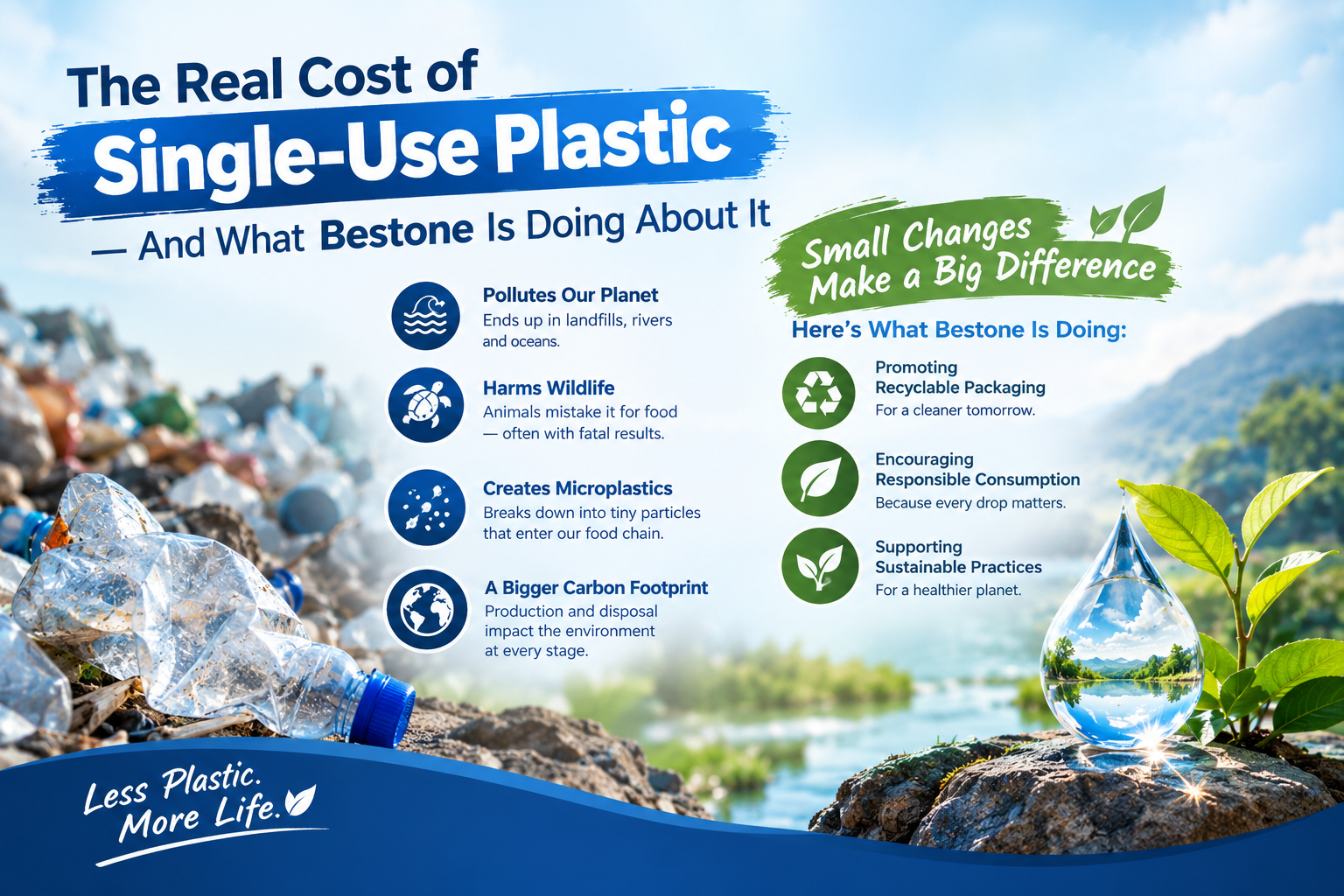
Every time you twist open a plastic water bottle, you’re taking part in a system that looks convenient on the surface but carries a price tag most of us never see. That price isn’t paid at the checkout counter — it’s paid by rivers, oceans, landfills, and, increasingly, our own bodies. At Bestone, we believe it’s time to talk honestly about what single-use plastic really costs, and what a genuine alternative looks like.
The Hidden Price Tag of “Convenience”
A single plastic water bottle takes mere seconds to drink and centuries to disappear. Most plastic bottles are made from PET (polyethylene terephthalate), a material that can persist in the environment for 400 years or more. It doesn’t biodegrade in any meaningful human timeframe — it simply breaks down into smaller and smaller fragments, eventually becoming microplastic.
Consider the numbers: the world produces hundreds of billions of plastic bottles every year — more than a million every minute, according to widely cited industry estimates. Less than a third of these are ever collected for recycling. The rest end up in landfills, are incinerated, or leak into rivers and oceans, where they break apart into particles small enough to be ingested by fish, absorbed into soil, and — ultimately — consumed by us.
This is no longer a distant, abstract problem. Microplastics have been detected in drinking water, sea salt, human blood, and even placental tissue. We are, quite literally, drinking the packaging we thought we were disposing of responsibly.
It Takes More Water to Bottle Water Than to Drink It
Here’s an irony that rarely makes it onto a bottle label: producing a single liter of bottled water can require up to three liters of water in the manufacturing process alone. Add to that the crude oil and energy used to manufacture, shape, cool, and transport plastic bottles, and the carbon footprint of bottled water becomes dramatically larger than that of water from a home purification system — by some estimates, hundreds of times greater.
Then there’s transportation. Bottled water is heavy, bulky, and often shipped across states or countries before it ever reaches a shelf. Trucks, ships, and refrigeration units all burn fuel to move something that, in most cases, could have come straight from a tap or a purifier sitting a few feet away.
The Economic Cost No One Talks About
Beyond the environmental toll, single-use plastic quietly drains household budgets. A family that buys bottled water daily can end up spending significantly more per year than they would on a one-time investment in a quality water purifier. Multiply that by millions of households, offices, schools, and hospitals, and the “convenience” of single-use plastic starts to look like one of the most expensive habits we’ve collectively normalized.
Businesses feel this too. Offices that stock cases of plastic bottles are paying for packaging, logistics, storage, and waste disposal — costs that recur every single month, indefinitely, with nothing to show for it once the bottles are empty.
The Health Question We Shouldn’t Ignore
Plastic bottles, especially when exposed to heat, sunlight, or prolonged storage, can leach chemicals such as antimony and bisphenol-A (BPA) into the water they hold. While regulatory bodies set safety limits, growing research suggests that repeated, long-term exposure to these compounds — even at low levels — deserves more scrutiny than it currently receives. Add microplastic contamination to that list, and the case for rethinking how we access drinking water becomes even stronger.
So What Can Actually Be Done?
The good news is that the solution isn’t complicated — it’s a shift in habit and infrastructure, not a sacrifice in comfort. This is exactly the gap Bestone was built to close.
- Purification at the source, not bottling after the fact.
Instead of relying on a supply chain of trucks, factories, and plastic packaging, Bestone’s water purifiers and dispensers are designed to deliver clean, safe drinking water directly at home or in the workplace — cutting out the need for single-use bottles entirely. Advanced filtration removes impurities right where the water is consumed, so there’s no bottle to manufacture, ship, or throw away. - Designed for daily, reusable use.
Bestone’s dispensers and purification systems are built around the idea of refill, not disposal. A single unit can replace thousands of plastic bottles over its lifetime, turning what used to be a recurring waste stream into a one-time, long-term investment. - Reducing the invisible costs alongside the visible ones.
By eliminating the need to constantly purchase, transport, and discard plastic bottles, Bestone helps households and businesses reduce both their environmental footprint and their ongoing spending — proving that the sustainable choice and the economical choice can be the same one. - Making the switch easy, not idealistic.
We know that meaningful environmental change only sticks when it’s practical. That’s why Bestone focuses on dependable, easy-to-maintain purification technology that fits seamlessly into everyday life — no behavioral overhaul required, just a smarter starting point for how your water reaches your glass. - Educating, not just selling.
Part of tackling the plastic crisis is helping people understand the real cost behind the convenience. Through initiatives like this one, Bestone aims to be transparent about the problem — not just a company offering a product, but a voice encouraging a broader shift in how households and businesses think about their water.
A Small Switch, A Large Ripple Effect
It’s easy to feel like individual choices don’t matter against a global crisis of this scale. But every household that replaces a case of plastic bottles with a dependable purification system removes hundreds of bottles from the waste stream every year. Multiply that across neighborhoods, offices, schools, and cities, and the ripple effect becomes substantial.
Single-use plastic was never really about convenience — it was about a lack of better alternatives. That’s changing. With reliable purification technology now more accessible than ever, the “convenient” choice and the responsible choice no longer have to be in conflict.
Final Thoughts
The true cost of single-use plastic isn’t printed on the label — it’s measured in centuries of waste, in strained ecosystems, in household budgets quietly bleeding money, and in the microplastics we now carry inside us. At Bestone, we believe clean water shouldn’t come wrapped in a problem. Our purification systems exist to give people what they actually want — safe, great-tasting water — without the environmental and financial baggage that comes with a bottle.
Making the switch isn’t just good for the planet. It’s simply a smarter way to drink water.